

New Research Reveals American Restaurants Are Leaving $12.6 Billion on the Table When Allergen Information Is Unclear
The Nutritics 2026 Allergy Dining Report in conjunction with Pollfish finds restaurants risk losing an average of $78 per table when allergen information is unclear.
For most restaurant operators, a lost guest doesn’t show up in the numbers. There’s no canceled check, no rejected reservation and no record of the table that stayed empty after one person in the group couldn’t confirm whether the restaurant could safely accommodate their food allergy. The restaurant’s loss usually happens earlier, on a phone screen or in a group chat, when someone says, “I’m not sure I can eat there,” and the plan changes.
That pre-visit moment is where allergy-affected diners make their decision: dine or move on. They review menus and look for signs that a restaurant takes allergen information seriously. When what they find is vague, hard to locate or missing, many of them move on.
The Nutritics 2026 Allergy Dining Report shows how often that happens and what unclear allergen information may be costing restaurants. For restaurants fighting rising costs and tighter margins, these new food allergy statistics reveal a staggering revenue leak hidden in plain sight.
Purpose of this Study
To understand how allergen transparency shapes the way Americans choose, visit and recommend restaurants, Nutritics surveyed 1,000 U.S. adults whose dining decisions are influenced by food allergies, either their own or those of someone in their household, social circle or workplace, in June 2026 using the third-party survey platform Pollfish.
Key Findings of the Nutritics 2026 Allergy Dining Report
- Unclear allergen information puts an estimated $78 in table spend at risk every time an allergy-affected diner chooses another restaurant, creating a $12.6 billion blind spot for restaurant owners and operators.
- Nearly all (95%) of allergy-affected diners have decided against a restaurant at least occasionally because they couldn’t easily find clear allergen information.
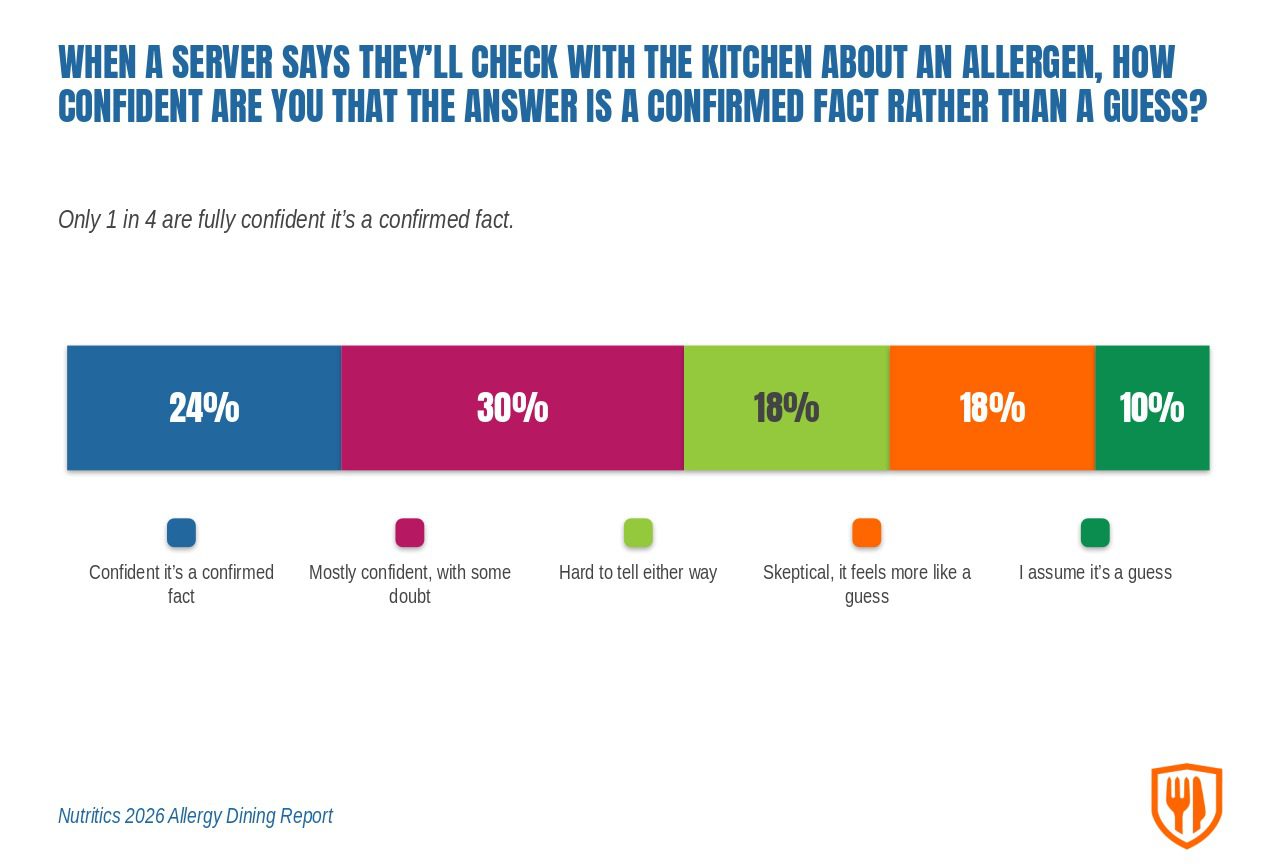
- Only 1 in 4 (24%) say they’re fully confident the answer is a confirmed fact when a server says they’ll check with the kitchen about an allergen.
- 61% have decided to skip eating out and eat at home instead after deciding a safe restaurant felt like too much work to find.
- More than half (51%) have chosen to try a new restaurant over a familiar one because the new restaurant’s allergen information was clearer or more reliable.
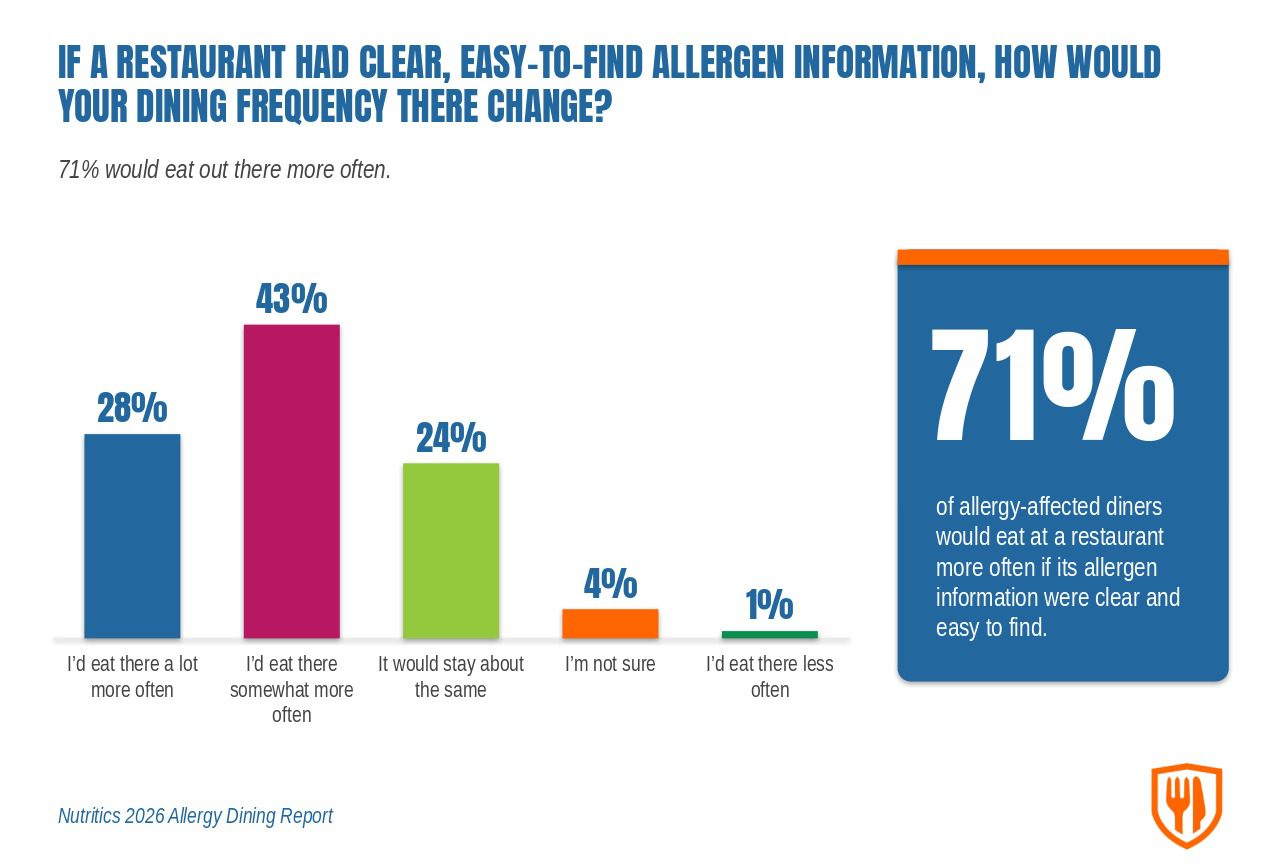
- 71% say they’d eat at a restaurant more often if it had clear, easy-to-find allergen information.
- More than half (52%) have recommended a specific restaurant to others because they trusted its allergen information.
- Among parents whose child’s allergy shapes dining decisions, 78% say they’d eat out more often at a restaurant with clear allergen information.
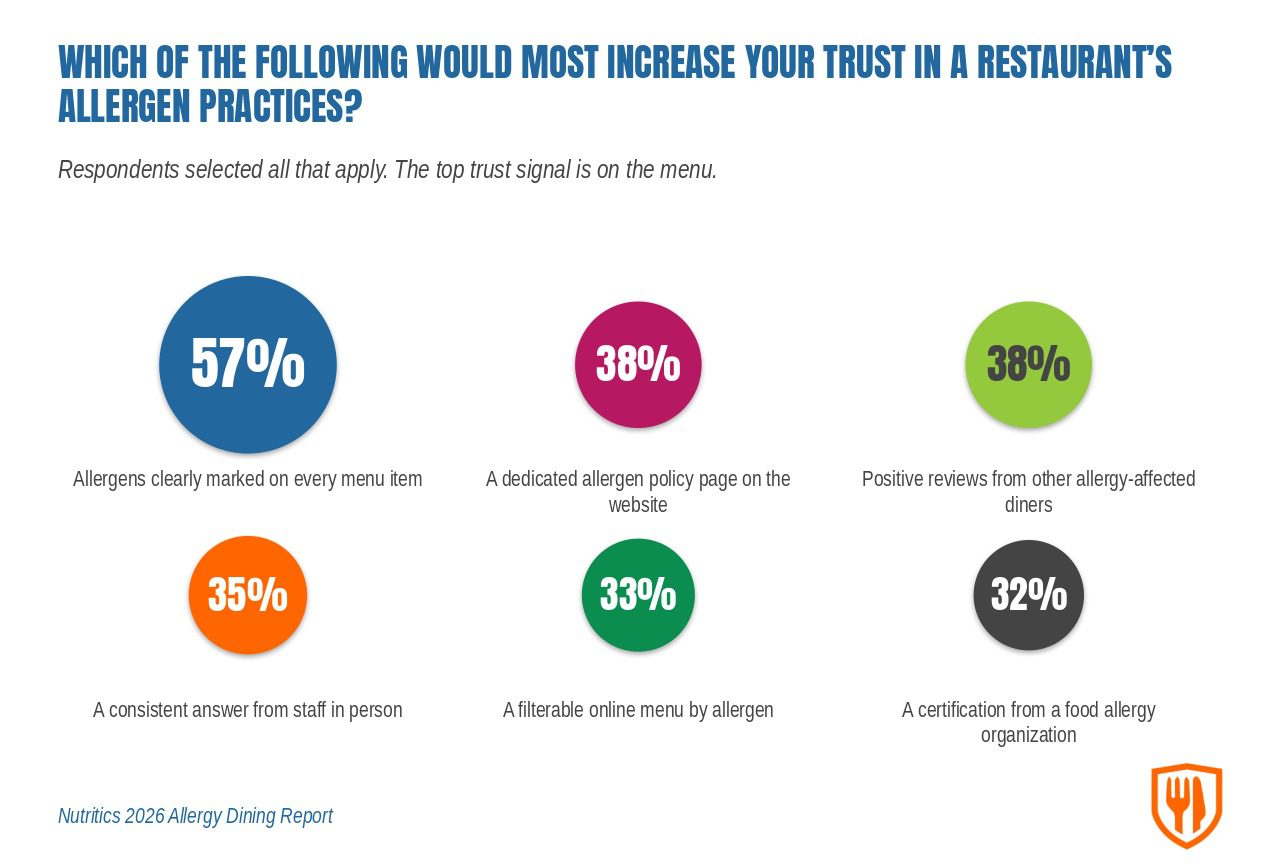
- The top factor that would increase trust in a restaurant’s allergen practices, cited by 57% of respondents, is allergens clearly marked on every menu item.
Every unclear menu has a price
Restaurant operators have always been cognizant of lost sales. What’s harder to measure is the group that checks the menu from home, can’t confirm it’s safe and never books.
Approximately 33 million Americans live with at least one food allergy. In the Nutritics survey, 41% of respondents say unclear allergen information causes them to avoid a restaurant more than half the time they run into it. 11% say it happens almost every time.
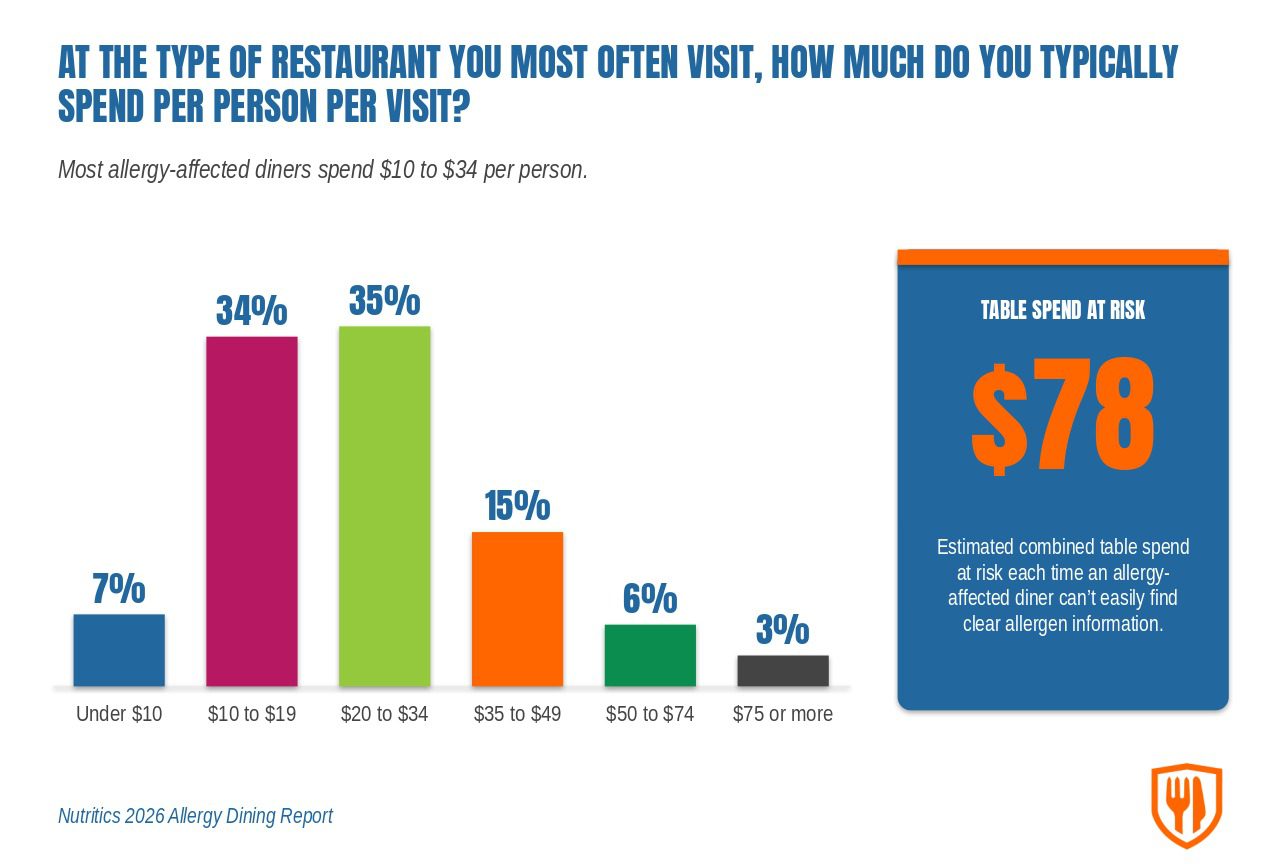
So what does that avoidance actually cost? The answer starts with a single missed table. Most allergy-affected diners spend $10 to $34 per person per visit: 34% fall in the $10 to $19 range and 35% fall between $20 and $34.
On party size, 37% say one other person would have come along and 40% say two to three others would have come. Multiply average spend by average party size and the estimated missed table comes to $78.
That figure only reflects a single avoided visit. If 41% of the 33 million Americans with food allergies avoid just one restaurant visit per month over unclear allergen information, the missed revenue across the industry comes to roughly $12.6 billion a year.
The $78 figure is where that starts – one party, one visit, one operator who didn’t know they were in the running.
For operators, this means the missed visit never appears as a loss; it simply never shows up.
Allergy concern has become a group decision
Food allergies affect more than the person who has them.
61% of respondents say their restaurant choices are shaped most often by someone else’s allergy, whether it’s a family member (18%), spouse (16%), friend (13%), child in the household (12%) or coworker (2%). The remaining 39% say their own allergy most often shapes where they eat. The person checking the menu may not have the allergy, but if they can’t find clear answers, the group’s plans can change.
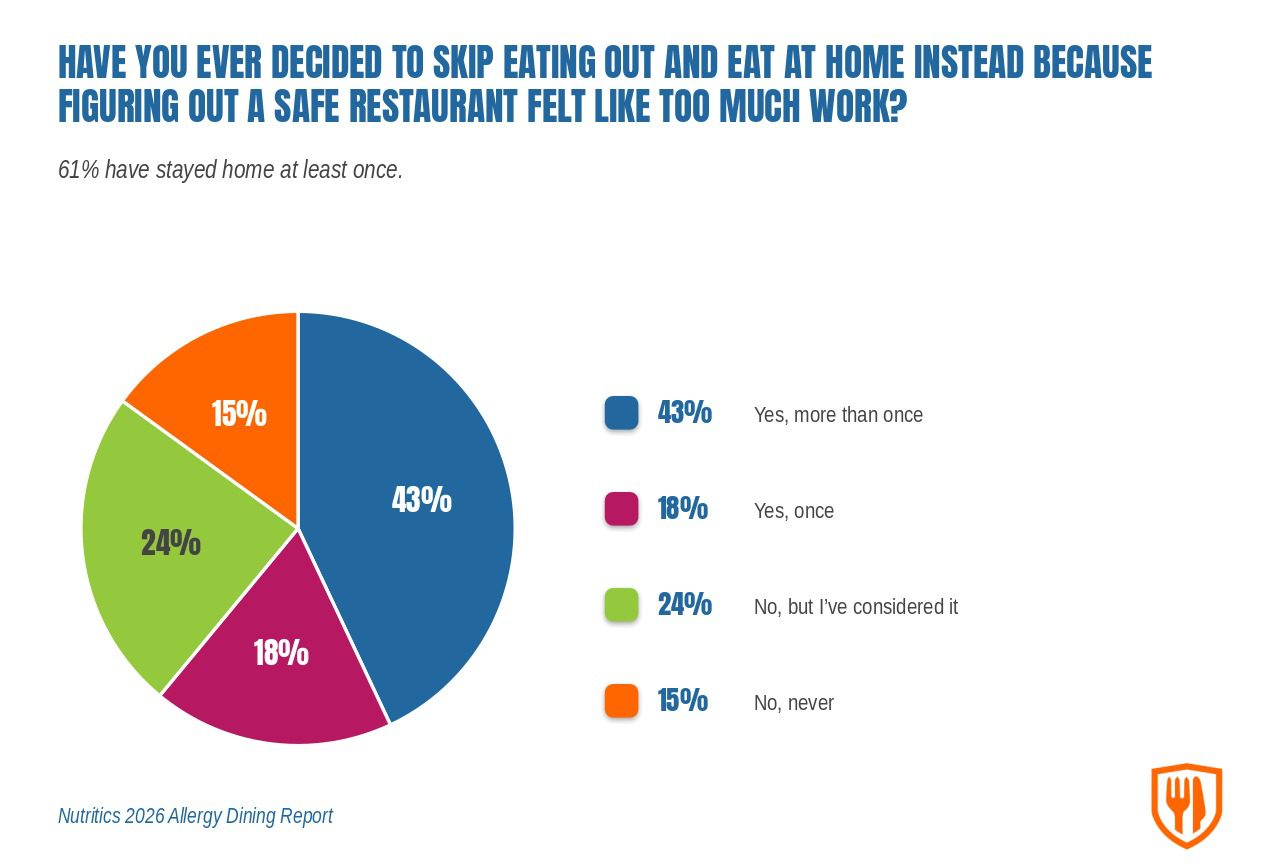
50% of respondents say food allergy concern has become a bigger factor in their restaurant choices over time. 18% say it has become much bigger. The number of diners making allergen-influenced decisions is larger now than it was a few years ago, and the effect on group decisions is growing with it.
For operators, losing the confidence of one diner can cost the whole table.
Allergy-affected diners screen before they book
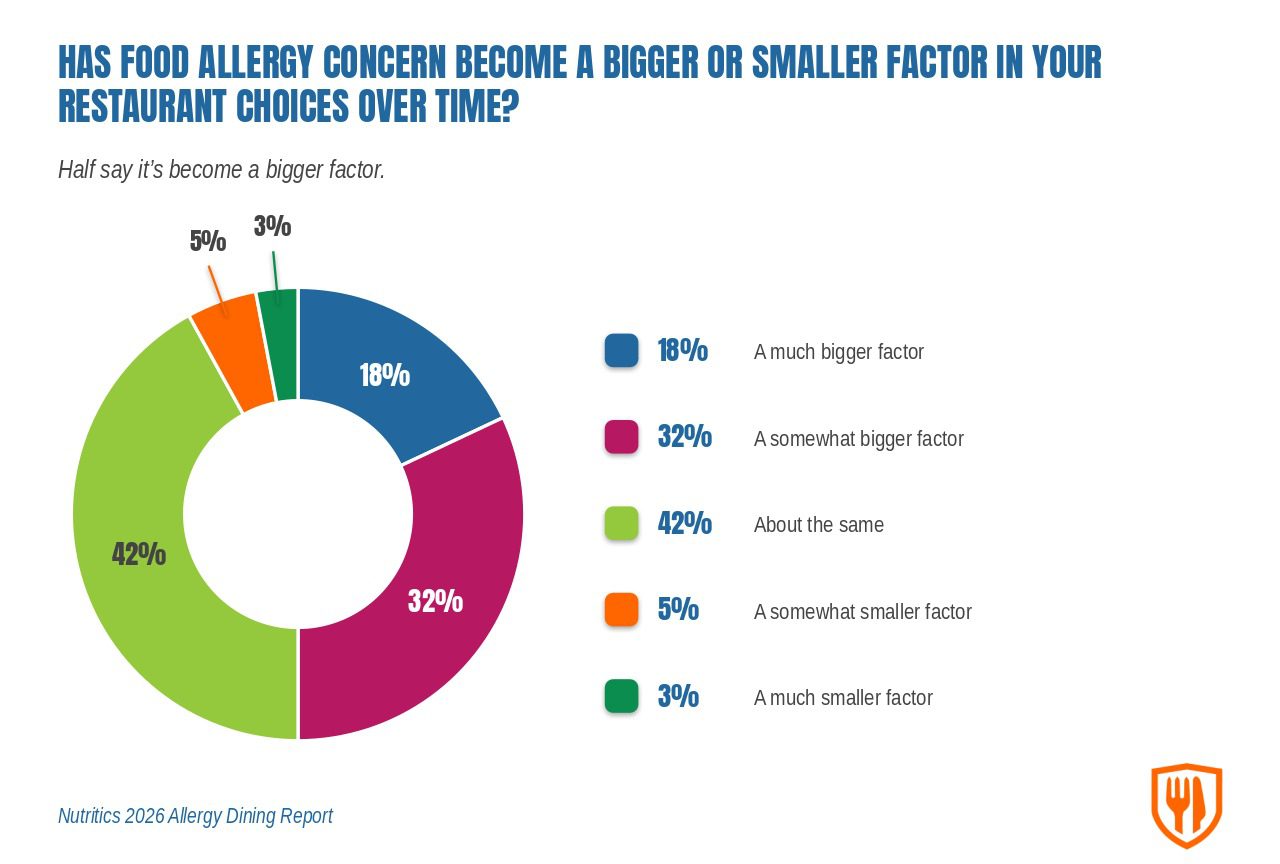
More than half (54%) look for allergens clearly marked next to each menu item, making a comprehensive allergen menu one of the strongest trust signals a restaurant can provide. 37% want a menu that can be filtered by allergen. 31% check for a dedicated allergen page on the restaurant’s website. 26% look inside delivery and ordering apps. If a restaurant doesn’t pass that check, most guests don’t call for clarification. They move on to one that does.
Parents making decisions around a child’s allergy set the bar even higher. Among those whose child’s allergy shapes dining decisions, 61% look for allergens clearly marked next to menu items versus 54% overall, and 45% look for a filterable menu versus 37% overall. For these guests, there is almost no room for uncertainty.
Nearly all respondents, 95%, have decided not to go to a restaurant at least occasionally after they couldn’t easily find clear allergen information. 41% say it happens more than half the time or almost every time.
For allergy-affected diners, clear allergen information is part of the decision to visit, and restaurants that don’t provide it are often removed from consideration.
When it’s too hard, guests stay home
There comes a point when uncertainty stops feeling like a hassle and turns into a reason to cancel the outing altogether.
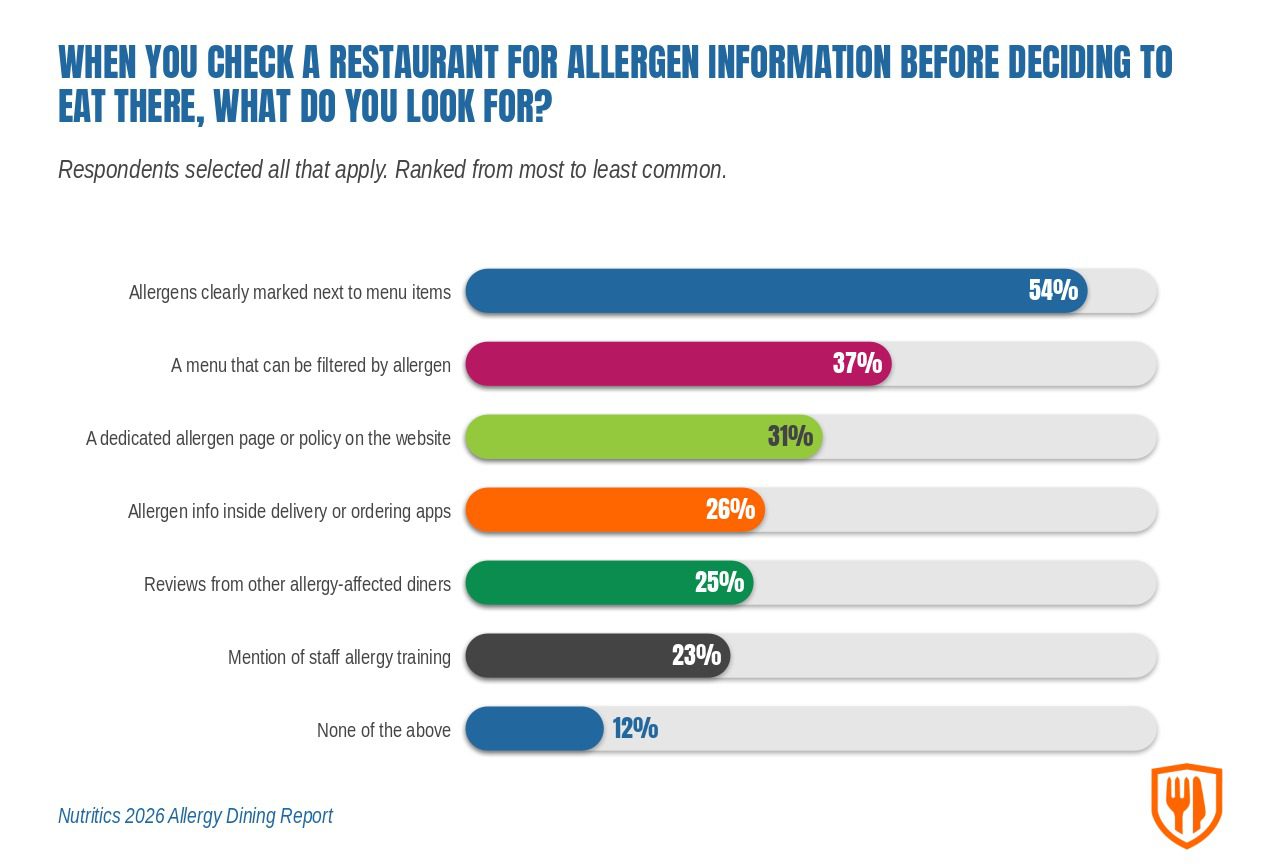
Nearly two-thirds (61%) say they’ve decided to skip eating out and eat at home after figuring out a safe option felt like too much effort. 43% have done it more than once. Another 24% say they’ve considered doing the same. In total, 85% of respondents have either acted on that impulse or come close to it.
Home is the safest option, and most allergy-affected diners have already chosen it. From an operator’s perspective, there’s no record of the table that stayed home. The group that hit its frustration threshold simply never appeared.
“Ask your server” has its limits
Many restaurants still rely on staff to fill the gap when allergen information isn’t written down. Those answers don’t settle the issue for many diners.
When a server says they’ll check with the kitchen, only 1 in 4 (24%) allergy-affected diners are fully confident the answer will be a confirmed fact. 30% say they’re mostly confident but still have some doubt. Nearly half (46%) remain skeptical or assume it’s a guess: 18% say it’s hard to tell, 18% are skeptical and feel it’s more like a guess, and 10% assume it’s a guess outright.
Asked to compare how much they trust a server’s answer versus written or digital allergen information, respondents are nearly split: 31% trust a server more, 32% trust written or digital sources more and 37% trust them about the same. When those two sources support each other, diners who need certainty before ordering are more likely to find it. When only one is in place, the answer may still fall short.
When allergy-affected diners raise a concern, only 47% say it almost always or often feels like the restaurant is prepared to handle it. 42% say it only sometimes feels that way. The gap between how prepared a team may feel and how often diners actually feel taken care of is exactly where documented allergen systems can help.
For operators still relying on verbal staff answers to cover allergen questions, most allergy-affected diners will leave with some level of uncertainty even after asking.
Unclear info routes guests to a competitor
When a menu fails allergy-affected diners’ screening, they seek other options.
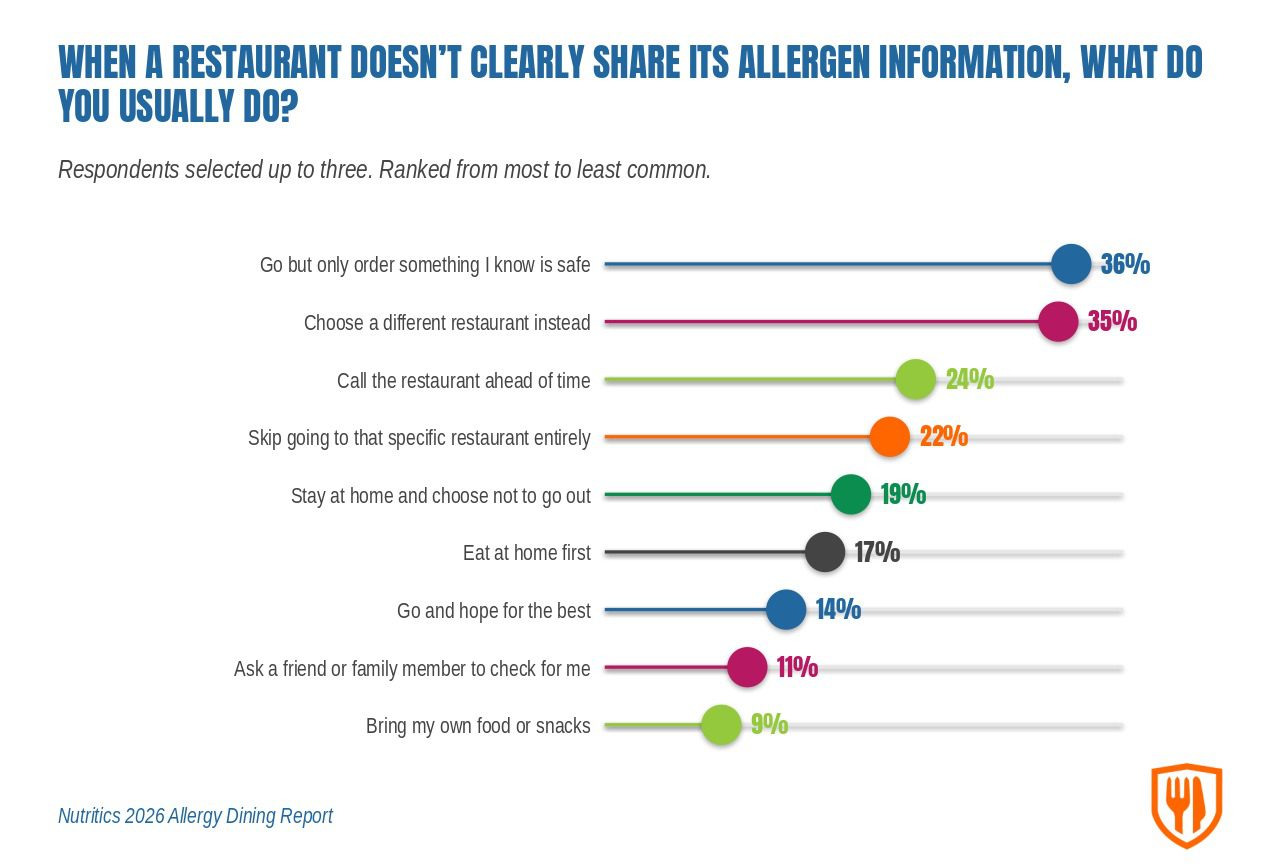
If a restaurant’s allergen information doesn’t give diners the confidence they need, most don’t wait around. 22% skip that specific restaurant entirely and 35% choose a different restaurant instead. Taken together, more than half (57%) cross the restaurant off the list before a table is ever booked.
The guests who still go often come with limits. 36% say they go but order only something they already know is safe, which can lower spending and keep anxiety high through the meal. 24% call ahead to verify. 14% go and hope for the best, which carries its own risk.
Parents are more likely to send the visit somewhere else. 43% say they’d choose a different restaurant when allergen information is unclear, versus 35% overall, and 35% say they’d call ahead, versus 24% overall. The family table an operator could have won is often already headed to the place with clearer information.
Clear allergen info converts avoiders into regulars
The diners being lost to allergen confusion aren’t avoiding restaurants altogether. They’re trying to find food allergy-friendly restaurants they can trust, and once they find it, they return.
Nearly three-quarters (71%) say they’d eat at a restaurant more often if it had clear, easy-to-find allergen information. 28% say they’d eat there a lot more often. Only 1% say they’d eat there less. The chance to recover visits isn’t a projection. It’s a stated preference from most of this audience.
More than half (51%) of respondents have chosen a new restaurant over a familiar one after the new restaurant’s allergen information felt clearer. 29% have done it more than once, and another 35% say they haven’t made that switch yet but would. Restaurants with clearer menus are pulling guests away from places they already knew.
More than half (52%) have recommended a specific restaurant to others after trusting its allergen information. 32% have done it more than once, and another 32% say they haven’t recommended a restaurant for this reason yet but would.
This effect is strongest among parents. Among parents of allergy-affected children, 78% say better allergen information would make them more likely to visit a restaurant, with 38% saying they’d eat there a lot more often.
The same pattern appears in recommendations. Among parents, 38% have switched their regular go-to more than once versus 29% overall, and 36% have recommended a restaurant specifically for its allergen information more than once versus 32% overall.
For restaurants that make allergen information easy to find, this audience responds with more frequent visits and unprompted referrals.
The top trust signal is on the menu
Operators trying to build trust with allergy-affected diners often assume they need a major infrastructure overhaul. The data points to a simpler starting place.
The top trust-builder is allergens clearly marked on every menu item, cited by 57% of respondents. 38% say a dedicated allergen policy page on the website would increase their trust, and 38% say positive reviews from other allergy-affected diners would do the same. 35% cite a consistent in-person answer from staff. Only 5% say none of the listed options would make a difference.
For operators looking for a starting point, the data is direct: mark allergens on the menu. It’s the signal this audience wants most, it helps convert potential guests and it shows the restaurant takes the issue seriously. Certification, filterable menus and staff training can support it further, but the foundation is what guests see next to the dish.
What operators should do next
The Nutritics 2026 Allergy Dining Report gives operators a clear picture of what’s at stake. Restaurants that invest in a clear allergen menu and position themselves as food allergy friendly are better placed to attract and retain allergy affected diners.
For multi-location operators managing allergen information across menus, or those dealing with compliance requirements such as California’s ADDE Act, a structured digital system makes it possible to deliver that clarity at scale and keep it consistent. The ADDE Act Knowledge Hub, created by Nutritics, is a practical resource for operators working through what the regulation requires and what may follow in other markets.
Mark allergens on every menu item: The ADDE Act requires disclosure of all nine major allergens: milk, eggs, fish, crustacean shellfish, tree nuts, peanuts, wheat, soybeans and sesame. Clear text or standard pictograms both meet the standard.
Keep disclosure consistent: Allergen information must match whether a guest is reading a printed menu, a menu board or an online ordering page. Delivery platforms are included under ADDE, and a QR code alone isn’t enough; a printed alternative must also be available. What a guest sees before they book should match what they find when they arrive.
Update disclosures whenever recipes or vendors change: Compliance doesn’t end at launch. Any time a recipe or vendor formulation changes, menus and digital formats need to reflect it. For multi-location operators, that means a system that pushes updates across channels without manual entry, because manual processes are where errors compound.
Add a cross-contact statement: Cross-contact notices aren’t required under ADDE, but they’re recommended. The survey data shows only 24% of allergy-affected diners fully trust a verbal “I’ll check with the kitchen” response. A written statement does more of that work before the question gets asked.
Frequently Asked Questions About Allergens at Restaurants
How do food allergies affect where people eat out?
How does allergen transparency affect restaurant revenue?
How does one person with a food allergy affect a whole dining group?
Which foods are most often linked to allergies?
Do diners trust restaurants that disclose allergens?
Do diners trust servers to answer food allergy questions?
What is the biggest allergen trust signal for restaurant guests?
How many Americans have food allergies?
What are the nine major allergens California restaurants must disclose under SB 68?
When does California’s allergen disclosure law go into effect?
Survey Methodology
Nutritics used the third-party survey platform Pollfish to conduct an online survey in June 2026 of 1,000 U.S. adults. The food allergy statistics presented in the report are based on the survey findings. Eligible respondents for the survey must have dined out more than once in the past six months. Respondents also had to report that food allergies or intolerances, whether their own or those of a household member, friend or coworker they frequently eat with, factor into their dining decisions. Researchers reviewed all responses for quality control.
Related Resources

Why Spreadsheets Fail for Compliance

Menu Data Management for Restaurant Chains

Restaurant Allergen Disclosure Requirements
SB-68 Compliance Checklist: How to Prepare for California’s Allergen Disclosure Law

ADDE Act Explained: What California Foodservice Operators Need to Know
Delivery Apps and Allergens: Who is Responsible?
Get the SB-68 Checklist or Talk Through Your Workflow
Use the checklist to review your current readiness, or speak to someone about managing allergen information across menus, channels, and locations.